
Insights · Model audit · July 2026 · 7 min
Five formulas that quietly cost basis points.
The errors that survive review are not dramatic. They are small, structural and directionally biased. These are the five we look for first.
The errors that survive review are not dramatic. They are small, structural and directionally biased. These are the five we look for first.
Audit enough underwriting models and a pattern emerges: the errors that make it to committee are rarely broken formulas. Excel is loud about those. The survivors are quiet: formulas that compute plausible numbers that are consistently, slightly wrong, almost always in the flattering direction.
A row of formulas with one pasted value in the middle, left over from a check someone ran eight versions ago. The column still foots, the sheet still ties and one year of expenses is frozen at a number that no longer relates to the assumptions. Find these by auditing formula consistency across every row, not by reading values.
Off-by-one errors in amortization schedules are endemic: a term of one hundred twenty months that amortizes for one hundred nineteen, or interest computed on the ending balance instead of the beginning. Each month is small. Compounded across the balance and the hold, the payoff figure at exit can miss by enough to move the equity multiple.
Expense recoveries modeled as a flat ratio of expenses, ignoring vacancy, slippage and caps. Recovery income quietly assumes one hundred percent occupancy while the rent line above it does not, and net operating income inherits the gap. The tell is a recovery ratio that never moves when occupancy does.
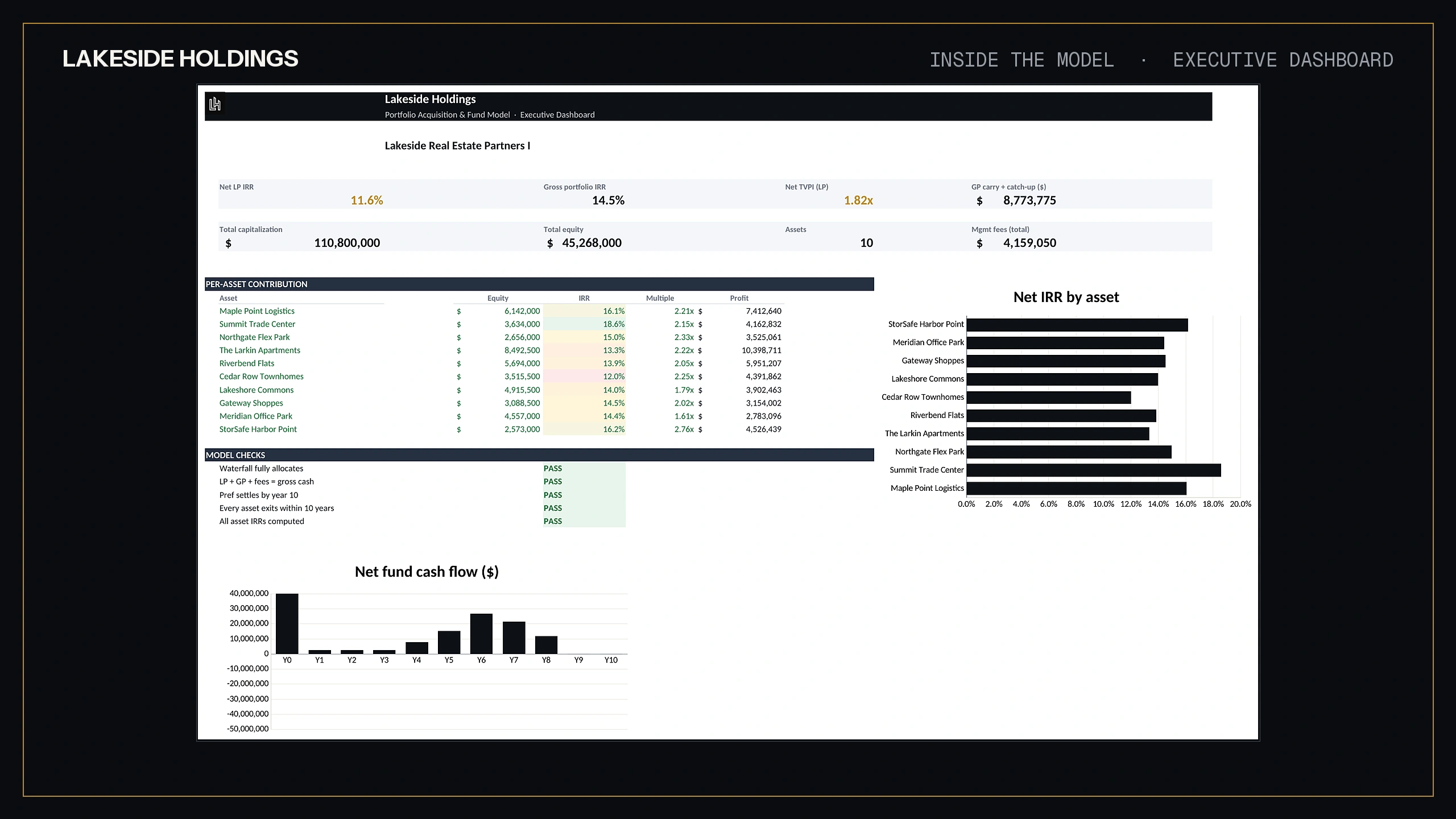
Financed origination fees and capitalized interest create genuine circularity: the loan must be large enough to pay the fee charged on the loan. Models handle this with iterative calculation switched on, which hides the loop and breaks the file on other machines, or with a hardcoded guess. The correct answer is a closed-form commitment: size the loan algebraically so the circularity never enters the workbook.
Annual IRR on cash flows that actually arrive monthly, acquisition dated to year zero while fees bleed in earlier, exit proceeds credited at year end when the sale closes mid-year. None of these are errors exactly. Together they are a convention, and the convention is worth real basis points of reported return. The fix is not a different convention. It is stating the one you use, applying it identically across every deal you compare and never switching mid-analysis.
All five errors share a property: the model still runs. Totals tie, sheets look clean and the answer is wrong by two to eighty basis points, biased toward optimism, compounding across every deal underwritten on the same file. That is why our audit practice re-runs every model independently instead of reading it, and why every model we publish ships with the audit rows visible. A file that decides where capital goes should prove itself every time it calculates.
We use an essential cookie to remember your preferences and privacy-first analytics that collect no personal data. By continuing you accept our Cookies Policy.We use one essential cookie and privacy-first analytics. Read the Cookies Policy.