
Insights · Waterfalls · July 2026 · 5 min
Pref, Catch-Up, Promote: Order of Operations.
Two partners can agree on the pref, the split and the promote, sign the same document and still argue at exit. The order of operations is the machine.
Two partners can agree on the pref, the split and the promote, sign the same document and still argue at exit. The order of operations is the machine.
Most waterfall arguments are not about the percentages. They are about the order. Two partners can agree on an 8 percent preferred return, an 80/20 split and a 20 percent promote, sign the same document and still end up arguing at exit, because the agreement never quite said which account each dollar fills first. The percentages are the headline terms. The order of operations is the machine, and the machine is where the money moves. The full definitions of the four buckets live in the waterfall essay. This page is only about the order they fill in, because on a garden variety deal the order alone is worth six figures.
Think in account balances, not formulas. The pref account accrues a percentage on unreturned capital and empties when paid. The capital account holds unreturned basis and shrinks as capital comes back. The catch-up account, where one exists, fills until the GP's share of profit distributions reaches the target. The promote is whatever is left, splitting at the agreed ratio. Every distribution, operating or capital event, walks these accounts in the agreement's stated order, fills the first one it hits and spills the remainder forward. A model that computes tiers as independent formulas instead of balances that fill and spill is guessing at the order, and the guess has a price.
Same deal as the waterfall essay. An LP invests 10 million. The deal distributes 650,000 a year for four years and 15 million at exit in year five, 17.6 million in total. The pref is 8 percent on unreturned capital, carried forward without compounding, accrued on the balance at the start of each year. Profits split 80/20 above. No catch-up in this walk, the catch-up rejoins at the end. The only question: when 650,000 of operating cash arrives each year, which account does it fill first?
Reading one, pref first. Each year the pref account accrues 800,000, cash pays 650,000 of it and 150,000 carries. By exit the pref account holds 1.4 million. The 15 million pays the pref, returns the 10 million of capital and leaves 3.6 million of profit to split. The GP's 20 percent is 720,000.
Reading two, capital first. Each year the 650,000 returns capital instead, so the capital account falls to 9.35, then 8.7, then 8.05, then 7.4 million, and the pref accrues on the shrinking balance while going unpaid: 800,000, then 748,000, then 696,000, then 644,000, then 592,000 in year five, 3.48 million in total. At exit the 15 million returns the remaining 7.4 million of capital, pays the 3.48 million of accrued pref and leaves 4.12 million to split. The GP's 20 percent is 824,000.
Same deal, same total distributions, same signatures. Reading one pays the GP 720,000 and reading two pays 824,000, a 104,000 swing on nothing but the order in which operating cash fills the accounts. The LP's IRR moves from 12.19 to 12.05 percent. And both readings pass the audit check that governs every waterfall: 17.6 million allocated to the dollar. A model can be internally perfect and still be running the wrong reading of your agreement. Arithmetic cannot catch a drafting ambiguity. Only the account walk can.
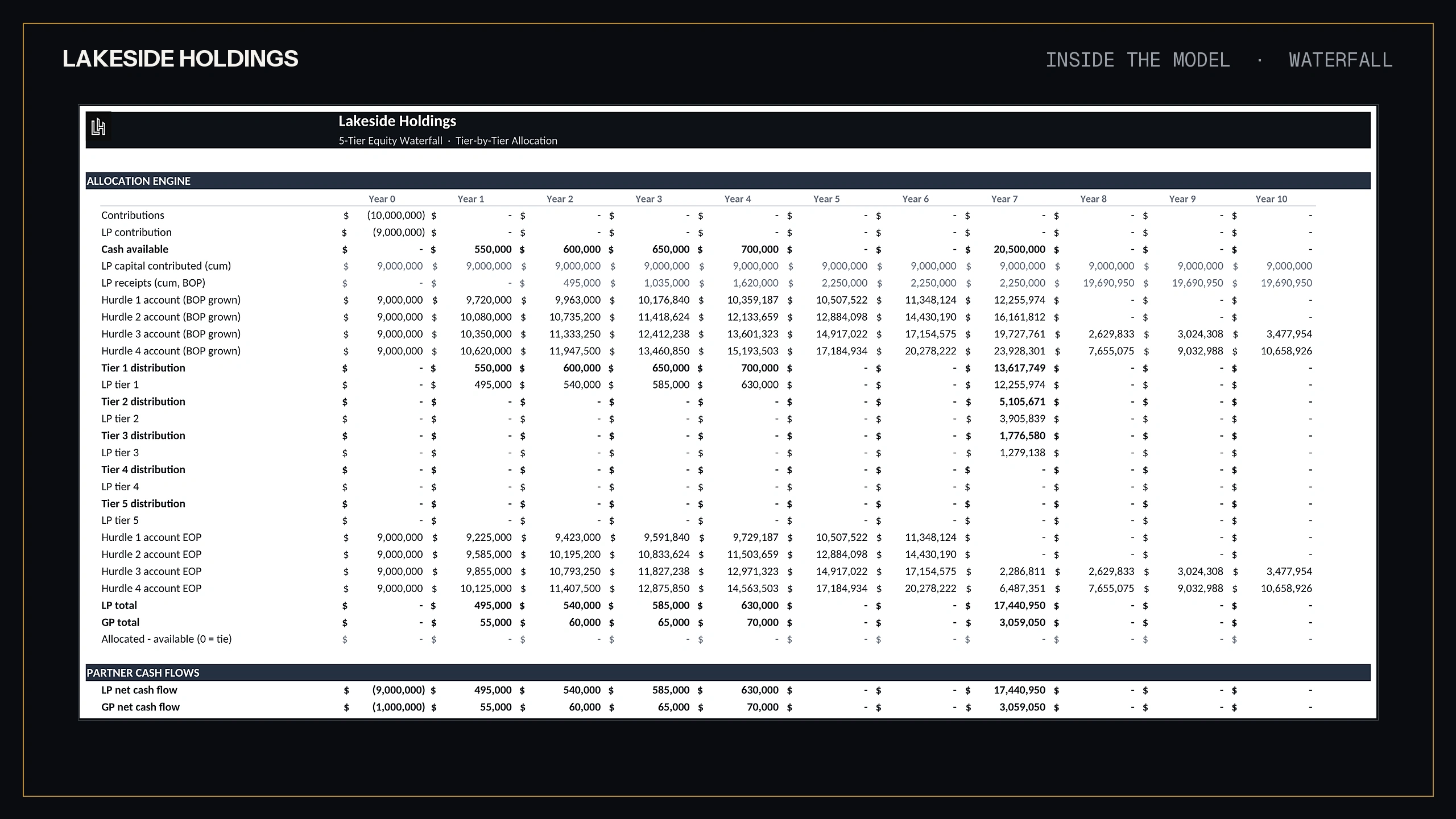
Here is the part that surprises people. Add a 100 percent catch-up to 20 percent of profits and rerun both readings. In reading one the catch-up fills to exactly 1.0 million, in reading two to 870,000, and the GP lands on 1.52 million either way, because the catch-up trues the GP up to its target share of profit no matter how the earlier accounts filled. A full catch-up makes the GP's total indifferent to the operating-cash order. A partial catch-up or none leaves the order live. So the two clauses have to be read together: the weaker the catch-up, the more the order of operations is worth arguing about, and a no-catch-up deal is precisely the deal where the ordering sentence deserves a lawyer's hour.
The order of operations lives in one place, the sentence that begins "distributions of net cash flow shall be applied first to" and the matching sentence for capital events. Read both. Check whether operating cash and capital proceeds walk the same order or different ones, whether pref accrues on committed or unreturned capital, and whether a refinance is a capital event that returns basis or ordinary cash that pays pref. In audits we find models that quietly restart pref accrual after a refi, promote paid on operating cash the agreement reserved for capital events and sensitivity tables that rerun NOI but not the account walk. The fix is structural, accounts that fill and spill in the agreement's stated order with an audit row summing every account against the money. That is how the JV Equity Waterfall engine in our library is built, and every model we publish is verified against an independent replica before release.
State your order as a sentence: "Operating cash fills this account first, then that one, and a capital event walks this order instead." If you can finish it from your agreement's own distribution clause, the order is underwriting. If you have to infer it from what the model happens to do, the model is deciding a legal question, and that is the one job it should never have. Paste your cash flows into the engine and walk the accounts. The free screener and the models are on the site.
The percentages are the headline. The order is the money. The model decides the deal.
We use an essential cookie to remember your preferences and privacy-first analytics that collect no personal data. By continuing you accept our Cookies Policy.We use one essential cookie and privacy-first analytics. Read the Cookies Policy.