
Insights · Rent roll · July 2026 · 3 min
The rent roll is lying to you, politely.
Same building, same tenants, five different truths depending on which report you were handed. The five polite lies, and how to force one honest format.
Same building, same tenants, five different truths depending on which report you were handed. The five polite lies, and how to force one honest format.
Every rent roll arrives in a different shape because every property manager's software exports a different shape. Same building, same tenants, five different truths depending on which report you were handed. Underwriting starts with forcing that document into one honest format, and most of the errors that survive to closing were born in this step.
**The occupancy lie.** A rent roll shows physical occupancy, the percentage of units with a body in them. It says nothing about economic occupancy, the percentage of scheduled rent actually being collected. A building can be 95 percent full and 82 percent paid. Ask for the delinquency report next to the rent roll, always.
**The in-place lie.** The rent column usually shows the contract rent as of the report date. It hides concessions quietly amortizing in the background, a month free here, a discounted first year there. Effective rent and face rent diverge exactly when the market softens, which is exactly when you are buying.
**The market rent lie.** The market rent column was typed by someone with an interest in the answer. Treat it as the seller's opinion, not data. Your loss to lease number is only as honest as this column, so rebuild it from comps before you let it into the model.
**The expiration lie.** A rent roll is a snapshot, but the risk lives in the schedule. Sort every lease by expiration and look at the concentration: three anchor leases rolling in the same year is a refinancing problem wearing a rent roll costume. This is doubly true in industrial, where one tenant can be half the income.
**The blank cell lie.** Blanks get filled by optimistic analysts. A blank square footage, a blank start date, a blank deposit: each is information about the seller's records, and inventing a value destroys that information. Blanks stay blank until the source document answers.
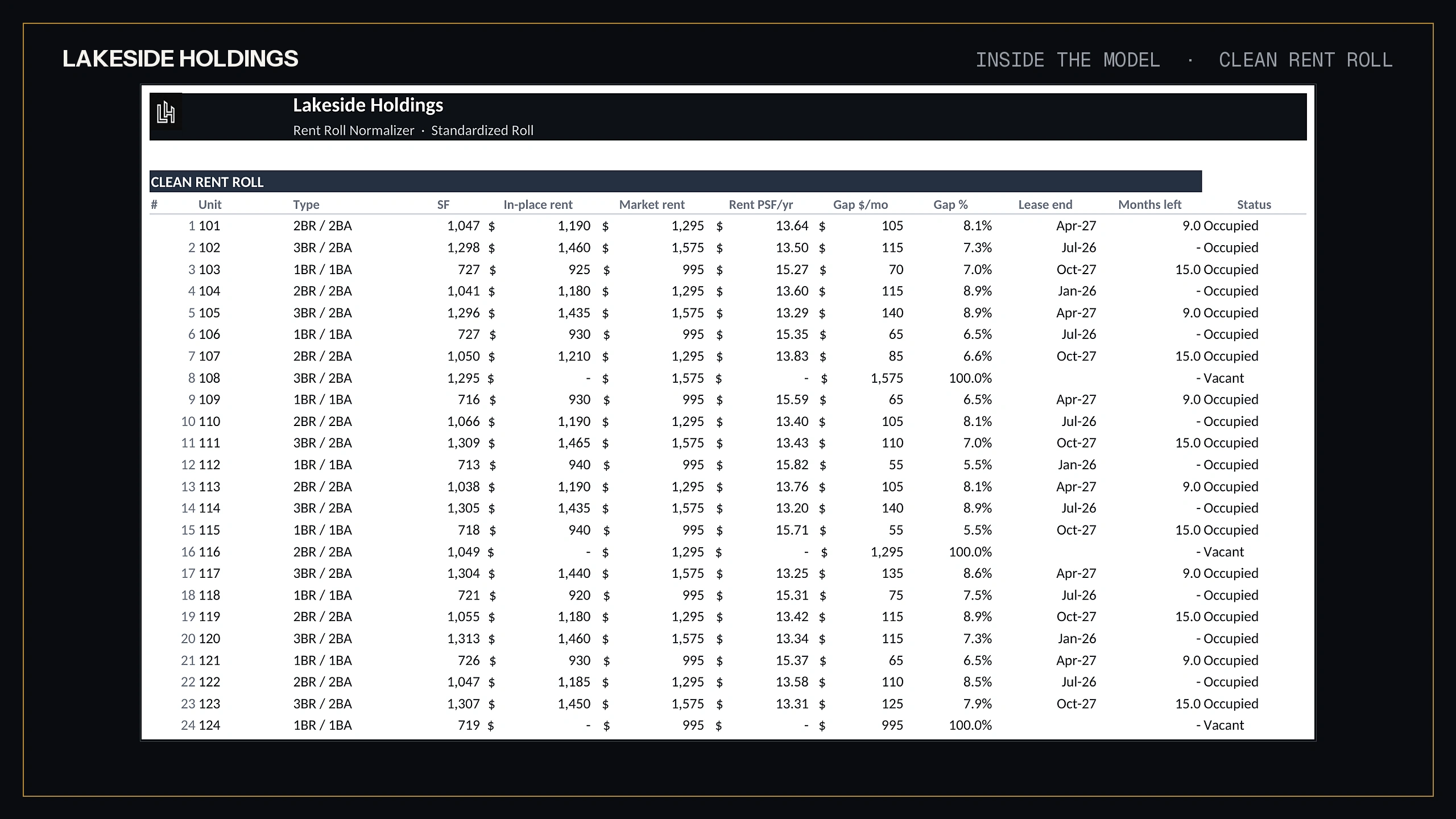
Paste the roll in as values, never as linked formulas to someone else's workbook. Map the seller's columns to your standard once: unit, type, square feet, tenant, start, expiration, in place rent, market rent. Then reconcile two numbers against the source before anything else: unit count and total scheduled rent. If either is off, the mapping is wrong and every downstream number is decoration.
Only then read the outputs: loss to lease by unit type, the expiration schedule by year, rent per square foot against the comp set and the weighted average lease term if you are in commercial. Our Rent Roll Normalizer runs precisely this workflow, paste as values, map the columns, read the outputs, with the reconciliation checks built in as permanent PASS or CHECK rows.
The model decides the deal. The rent roll just testifies, and it needs cross-examination.
For informational and educational purposes only. Not investment, legal or tax advice.
We use an essential cookie to remember your preferences and privacy-first analytics that collect no personal data. By continuing you accept our Cookies Policy.We use one essential cookie and privacy-first analytics. Read the Cookies Policy.